
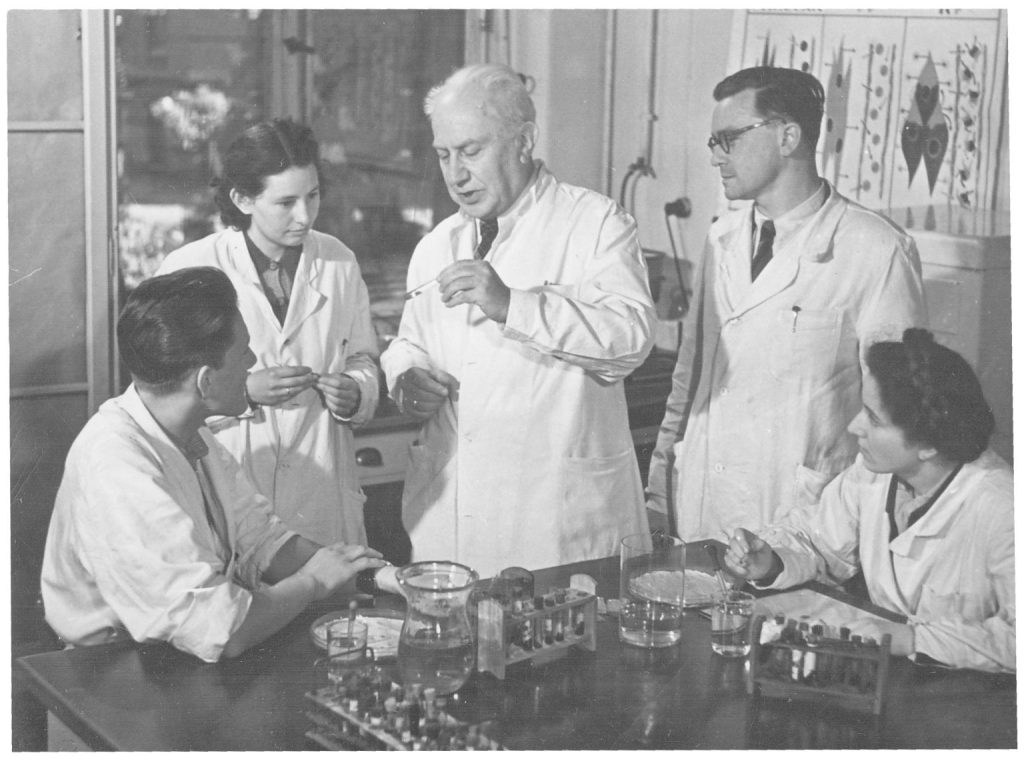
“Those who do not know the past cannot shape the future”
These words were spoken by Professor Ludwik Hirszfeld, an outstanding scholar, full professor at the University of Wrocław, and the first dean of the Faculty of Medicine in what was then Polish Wrocław. It was he who, in a windowless room, delivered the faculty’s first lecture in Polish, titled “Modern Views in Bacteriology.”
Ludwik Hirszfeld was a Renaissance man with wide-ranging interests, a visionary, a patriot, a physician, a brilliant lecturer, the founder of the Polish school of immunology, and the pioneer of a new field of science—seroanthropology. His greatest scientific achievement was proving the heredity of blood groups and introducing their nomenclature: A, B, 0, and AB.
Professor Ludwik Hirszfeld was the founder and first director of the Institute of Immunology and Experimental Therapy, Polish Academy of Sciences, established on December 2, 1952, by a resolution of the Presidium of the Polish Academy of Sciences. After assembling the research staff and preparing the facilities at 4 Tytusa Chałubińskiego Street, the Institute began operations on February 6, 1954. Unfortunately, after less than a month in the position of Director, Professor Hirszfeld passed away.