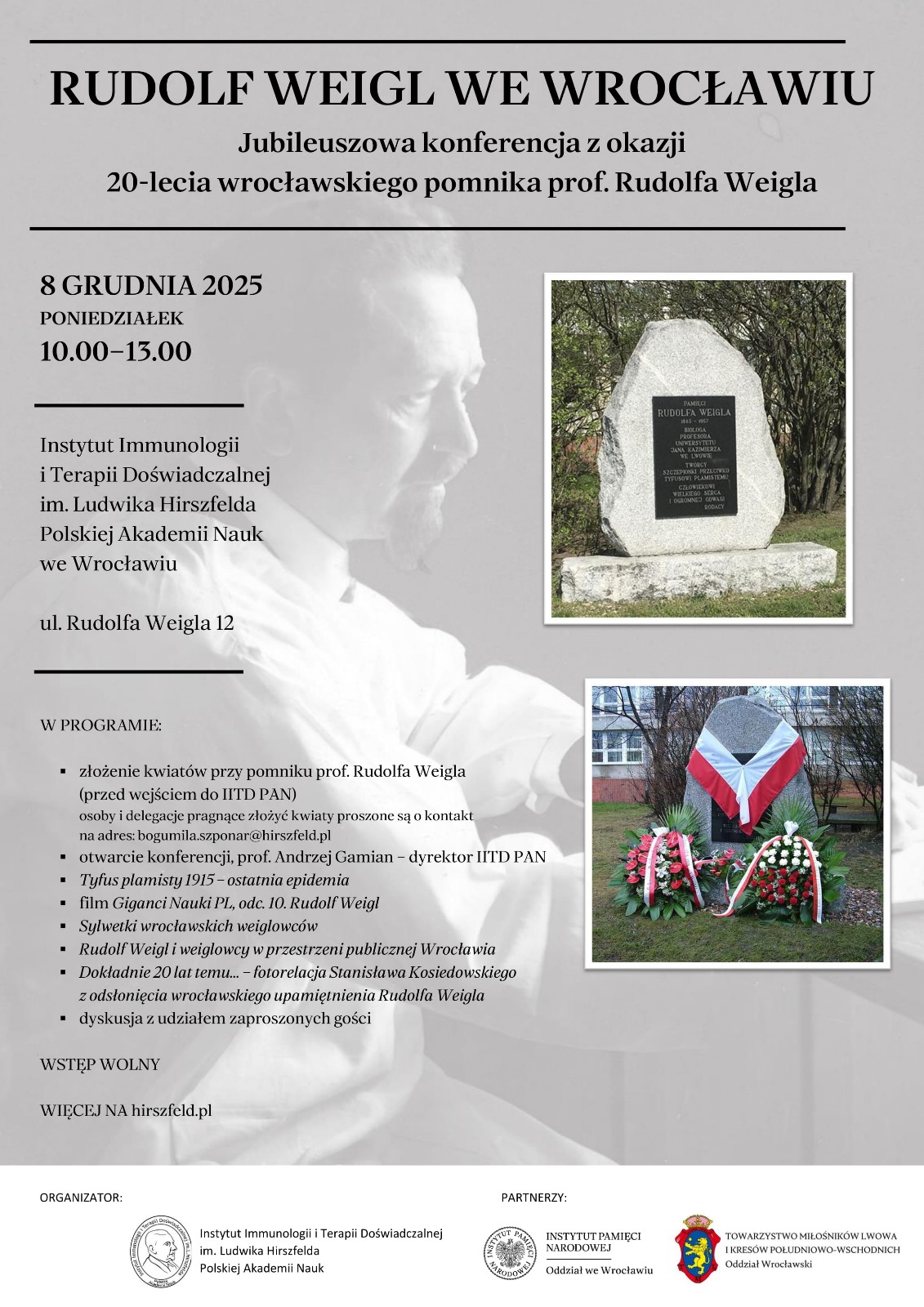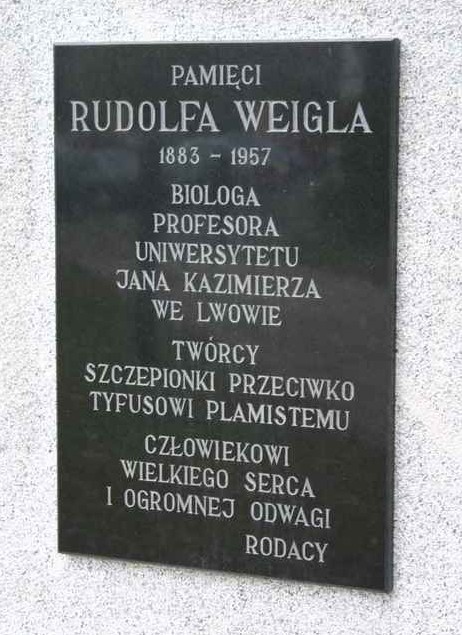
A monument dedicated to the memory of Professor Rudolf Weigl, the creator of the typhus vaccine, was unveiled in front of the Hirszfeld Institute on December 8, 2005. The obelisk was funded by public donations, mainly from the residents of Lviv – the “Weiglers” – a handful of Weigl’s last colleagues, and lice feeders who, thanks to a certificate from the Institute for Research on Typhus and Viruses in Lviv (1939-1944), survived the war, avoiding deportation to the Reich, prisons, and death.
Twenty years later, on December 8, 2025, at 10:00 a.m., we will meet in front of the monument, then proceed to the auditorium and discuss the phenomenon of Weigl’s laboratory and Wrocław’s “Weiglowcy” (Weigl’s followers).
Rudolf Weigl, a world-renowned scientist, was barely tolerated by the communist authorities after the war. He never came to Wrocław himself, but over sixty “Weiglers” settled here and became involved in building the city’s academic community. They also created our Institute, among them Prof. Stefan Ślopek, its long-time director, as well as laboratory assistant Tadeusz Kidankiewicz and technician Roman Superat.
“Being a Weiglian meant almost complete immunity. Nearly a hundred professors, including botanist Stanisław Kulczyński and geographer Alfred Jahn—later rectors of the University of Wrocław—Stefan Banach, a world-renowned mathematician, artists such as poet Zbigniew Herbert, Stanisław Skrowaczewski, conductor, and almost the entire command of the Lviv District of the Home Army – all of them fed lice. Several thousand people passed through Professor Weigl’s laboratory.” (A. Augustyn, 2007)
The event is organized by the Institute of Immunology and Experimental Therapy of the Polish Academy of Sciences in cooperation with its partners: the Wrocław Branch of the Institute of National Remembrance and the Society of Lviv and South-Eastern Borderlands Enthusiasts.
We cordially invite you to attend!