
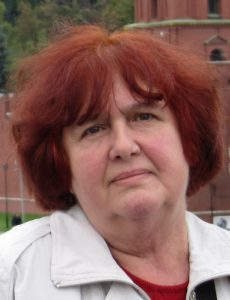
It is with great sadness and regret that we announce the passing of
Ewa Katzenellenbogen, PhD, DSc
She was born in 1946 in Gliwice. Between 1964 and 1969, she studied at the Faculty of Natural Sciences at the University of Wrocław, obtaining a master’s degree in biochemistry in 1969 with a thesis entitled ‘Products of exhaustive proteolysis of fibrinogen with trypsin, plasmin and thrombin’.
After graduating, between 1969 and 1975, she first worked as a trainee engineer and then as an assistant at the Department of Biochemistry of the Institute of Immunology and Experimental Therapy of the Polish Academy of Sciences, which at that time was located on Chałubińskiego Street in Wrocław. She was a member of the team led by Prof. Elżbieta Romanowska and was involved in immunochemical and serological research on bacterial endotoxins (lipopolysaccharides).
In 1975, she obtained a doctorate in natural sciences, by resolution of the Scientific Council of the IIET PAS on 7 November 1975 for her dissertation entitled ‘Immunochemical studies of Shigella flexneri serotype 6’.
After obtaining her doctorate (1976-2007), she worked as an assistant professor at the Department of Biochemistry of the Institute of Immunology and Experimental Therapy of the Polish Academy of Sciences. During that period (1976-1978), she completed a series of short-term internships (9 months) in the team of world-class chemist Prof. Bengt Lindberg, who specialised in sugar chemistry, at the Department of Organic Chemistry, Arrhenius Laboratory, Stockholm University. The research focused on structural analyses of phase I O antigens of Shigella sonnei and Shigella flexneri. In 1980, she was awarded the Team Award of the Faculty of Medical Sciences of the Polish Academy of Sciences for a series of works on structural research of Shigella sugar antigens.
From 1980 to 1982, she completed a postdoctoral fellowship at the prestigious National Research Council in Ottawa, Canada, in the group of Prof. Harold Jennings, co-creator of the currently available vaccine against Neisseria meningitidis type C, where she conducted structural research on polysaccharide antigens of streptococci, pneumococci and Legionella. This collaboration resulted in seven scientific publications.
After returning from Canada, she established close, long-term (1988–1991) scientific cooperation with Dr Nina Koczarowa and Prof. Yurij Knirel, an outstanding organic chemist from the N.D. Zielinski Institute of Organic Chemistry in Moscow, specialising in the study of bacterial polysaccharides. This collaboration was supported for years by the Office of Scientific Cooperation of the Polish Academy of Sciences, where, thanks to funds for foreign trips, scientists from both centres undertook scientific internships and carried out joint research. At that time, the institute was able to perform structural LPS studies in the field of analytical chemistry, while the Moscow centre had expertise in NMR spectroscopy. The contribution of both teams to the development of bacterial antigen immunochemistry was recognised in 2004 with the award of a joint prize from the Polish Academy of Sciences and the Russian Academy of Sciences ‘For contribution to science’ and a series of 15 publications entitled “Structural and serological studies of bacterial lipopolysaccharides of the Citrobacter and Hafnia genera”.
Ewa Katzenellenbogen obtained her postdoctoral degree in biological sciences in the field of immunochemistry by resolution of the Scientific Council of the IIET PAS on 4 December 2006, for her postdoctoral thesis entitled ‘Structural studies of Hafnia alvei lipopolysaccharides with particular emphasis on O-specific polysaccharides’. In 2007, she was employed as an associate professor at the Laboratory of Microbial Immunochemistry and Vaccines of the IIET PAS. From 2010 to 2019, she worked as an associate professor.
Professor Ewa Katzenellenbogen was the author of extensive serological and structural studies describing the structural variability of serotypes O of bacteria of the genera Shigella, Hafnia, Citrobacter, Edwardsiella, and Klebsiella. Her postdoctoral thesis was a comprehensive monograph describing the structural variability of Hafnia alvei. In her research, she collaborated with Dr Nina Koczarowa and Prof. Yurij Knirel, an eminent organic chemist from the N.D. Zielinski Institute of Organic Chemistry in Moscow, specialising in the study of bacterial polysaccharides. This collaboration was supported for many years by the Scientific Cooperation Office of the Polish Academy of Sciences. She has published scientific papers on immunochemistry and structural studies of LPS and capsular antigens in, among others, the European Journal of Biochemistry, Carbohydrate Research, Journal of Chemical Biology, FEMS Immunology and Medical Microbiology. Her total output includes 80 scientific publications. She devoted 50 years to scientific work at the Institute.
We will remember Ms Ewa not only as a good scientist, but also as an honest, kind, sociable and empathetic person, often referring to her notes and laboratory notebooks.
The funeral ceremony will take place at the family grave on Friday, 9 January 2026, at 1:00 p.m. at the St. Lawrence Cemetery on Bujwida Street in Wrocław (sector 2c, row 3, no. 16).
We extend our sincere condolences to the family and loved ones.
The management, colleagues, employees and doctoral students
of the Institute of Immunology and Experimental Therapy, Polish Academy of Sciences