
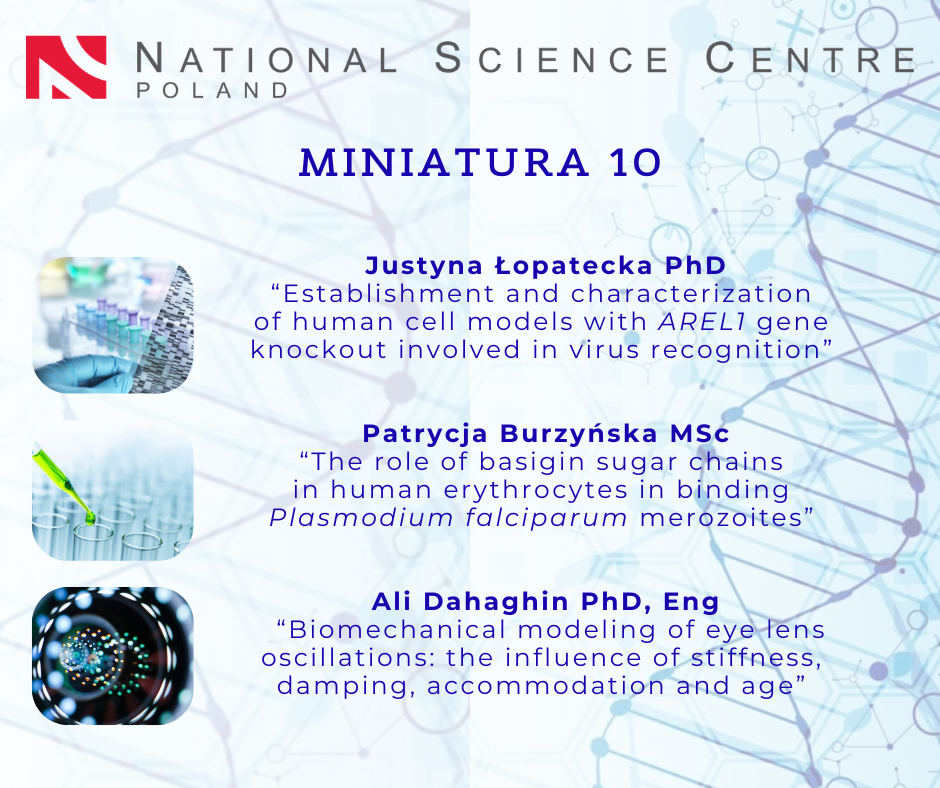
The National Science Center published the fifth ranking list for the Miniatura 10 competition. Among the recipients are three researchers from the Hirszfeld Institute of Immunology and Experimental Therapy: Justyna Łopatecka, PhD from the Laboratory of Tumor Molecular Immunobiology, Patrycja Burzyńska, MSc, from the Laboratory of Glycobiology, and Ali Dahaghin, PhD, Eng, from the Department of Anthropology.
Justyna Łopatecka, PhD will carry out the grant titled “Establishment and characterization of human cell models with AREL1 gene knockout involved in virus recognition.” This is an advanced approach in the fields of genetic engineering and immunology, designed to study the role of ubiquitination in the mechanisms of innate antiviral immunity. Cell models lacking the AREL1 gene allow for a precise assessment of how the HECT-type E3 ubiquitin ligase, which this gene encodes, influences the signaling cascades triggered upon viral entry into the cell.
The focus of Patrycja Burzyńska, MSc research under the grant “The role of basigin sugar chains in human erythrocytes in binding Plasmodium falciparum merozoites” will be to understand the interactions between basigin glycans and the parasite’s ligand, which is crucial for designing modern vaccines that block invasion and antimalarial drugs that prevent the parasite from recognizing human red blood cells.
Ali Dahaghin, PhD, Eng, will carry out the grant “Biomechanical modeling of eye lens oscillations: the influence of stiffness, damping, accommodation, and age.” He will focus on analyzing the phenomenon commonly known as lens wobbling (or crystalline lens oscillations). This phenomenon occurs in a fraction of a second after the sudden cessation of the eyeball’s rotational movement (during so-called rapid eye movements, or saccades). Studies on lens dynamics in vivo, as well as those using the finite element method (FEM) and fluid-structure interaction (FSI) models, show that the characteristics of these oscillations depend closely on mechanical parameters, the state of accommodation, and the patient’s age.
Ali Dahaghin’s award of the MINIATURA 10 grant is one of the outcomes of his work conducted as part of the OPUS 25 grant “The Human Sclera: The Role of Color and Contrast in the Perception of Others’ Eyes” (2023/49/B/HS6/02343), currently being carried out at the Department of Anthropology and led by Dariusz Danel, PhD DSc, Assoc. Prof. at the Hirszfeld Institute.
Congratulations!